Table of Contents

Most people from my generation know you from Big Mountain's 1994 cover of "Baby, I Love Your Way", but I was playing it the other day and my son recognised it from 'Jumanji', so you've really transcended generations here and music styles too. Did you think, back in those early 90s, that it would be such a huge and long-standing hit?
Quino: Yeah, you never really know. I mean, maybe some people do. I remember listening to the final for the first time and I thought, it sounded like a very strong song but it sounded so different to anything that I had ever recorded. And anything that I'd even heard.
So many of us thought Big Mountain had chosen this soft rock song by Peter Frampton and turned it into reggae but that's not exactly the story, is it?
Quino: No, the way it happened was, we had just had a real strong regional hit, our first album that was a song that I wrote called 'Touch My Light" and that was another weird little phenomenon because it was a poppy-reggae tune and again, it sounded like nothing that was going on at the time. The song ended up doing really well all throughout the south-west of the United States and you couldn't escape it in Los Angeles where all the producers were at and eventually the producer of "Baby, I Love Your Way" heard that song and contacted us. And he was also the director of the soundtrack for Reality Bites and he came up with the idea to do a reggae version. And the rest is history!
This explains a lot because as you said, it is so different to your other music in terms of being a pop song, while your other songs are very much about social justice issues, racism, inequality and such. So once "Baby, I Love Your Way" was such a a huge commercial success, what were those days like for you?
Quino: Well, you know, it was a pretty difficult time for me, personally. And yeah, with success you end up being in a position to live a bit of that glam lifestyle. I ended up staying and living in San Diego. I've coincidentally lived real close, within two hours of - in those days when there wasn't so much traffic - within two hours of Los Angeles. I would commute up there to do what we had to do and I would spend a bit of time doing the hoity-toity things around Hollywood but we never really fell into that. Reggae music has its own clique, its own community. And we pretty much stayed in those circles. I never really felt comfortable doing the Hollywood party thing and as a result, I just never really jumped into that. Fame was not easy for me to process. And I think I could've done a lot better job at it but it was too much too quick. I mean, we were the most famous Rasta band in the world for like two years. It was a very uncomfortable part of my life.
Advertisement
(interview with Big Mountain's Quino McWhinney continues below)
And was there pressure on you to keep making that type of music instead of the reggae that you wanted to make?
Quino: Absolutely. And that was another thing that was very uncomfortable. Our record company, we ended up signing with a major label, and they just had no idea. They didn't have the sensitivity to deal with a reggae band. Nobody really understood what reggae was all about. They didn't want to hear any. All this stuff that we were trying to do, they didn't understand. Any album with our label was a major battle, a dramatic thing. Again, they just wanted another "Baby, I Love Your Way". It's very difficult to work with those circumstances. So unfortunately, it wasn't a very gratifying time of life. Musically, we had success, we were working, we were touring a lot but I was very unfulfilled artistically.
It's very interesting to hear you say that because from an outsider's perspective, we think that fame is going to be so different, right?
Quino: Right. It's different.
Hey there bestie - sign up to our FREE Newsletter for more kind, no-gossip celebrity news!
Let's rewind it to your childhood for a bit. You are part Mexican and part Irish. you were raised by an African American man and you grew up in San Diego and parts of Central America -
Quino: (laughing) wow, you did some good research! Yeah, I was mainly 6 and 7 living in Honduras in Central America and my biological father, he worked for Dole Bananas for two years. So I got a really, how do you say, impressionable time of my life there. 6 and 7 is a time of your life when you're picking up a lot of information about what life is all about. And I really appreciate that experience because it really has given me a good perspective. And later on, we lived on the Caribbean side of it and I think that that had a lot to do with why I gravitated so easily to reggae music. My biological father, he passed away when I was young but he was basically Scotch-Irish and my mum, full-blooded Mexican, but my parents were both immigrants from Mexico. When I was 11 years old, my mom met my step-father and he was African American, so randomly I was kind of pressed into this perspective or scenario where I was really forced to confront the racism in such a very stark way in the United States. You know, growing up in a family that's part Black, part Mexican, part white, it just kind of put me on a mission to try to heal a lot of the racial tension that I felt around me.
And that's another reason you gravitated towards reggae?
Quino: And yeah, that was another reason why I gravitated towards reggae. It really kind of helped me process a lot of angst that I felt because of living in an environment like the United States. Naturally, I kind of almost had a defensive posture for my African American father. You know, he and I, well, it's really hard to get close to a kid when you adopt him when he was 11 years old. But he was an amazing dad. He provided a safe place for me and he was this intelligent, dynamic, professional, successful Black man, which you know, a lot of times, the way society tries to portray Black men? It's exactly the opposite of that. I had the example that just totally defied what the stereotype the United States has of Black men so I really just tried to dispel that myth.
There was a 10-year space from about 2003 that Big Mountain decided to take a bit of a break. And I heard you became a high school teacher in that time. You must've been the coolest teacher ever! Did you still have your dreads?
Quino: (laughing) No, I didn't. You know, I cut them off a year after "Baby, I Love Your Way".
Did you really?
Quino: I did.
What made you want to cut them off?
Quino: I couldn't deal with the attention. I really was trying to just hide and I was not happy with my record company so I tried to sabotage my career. I can't really explain it any other way. So yeah, Big Mountain continued to stay real busy for about another ten years after "Baby, I Love Your Way" and around 2005, I put the band to rest and I went back to school. And like you said, I eventually became a high school teacher and taught high school for seven years and elementary school for another two years after that.
Did everyone recognise you when you started teaching?
Quino: Yeah, everybody pieced everything together pretty easily. But I mean, for the first couple of weeks of school it's something exciting and novel for them, exciting. But I became just another teacher.
Yeah, then you're just Mr McWhinney?
Quino: (laughing) Mr McWhinney! Yes!
And so what made you want to get back into performing with Big Mountain again?
Quino: It's interesting because I just got through a trip to Indonesia and I remember the last time I went to Indonesia I was teaching high school. And I still didn't have my dreads, I still just had loose hair. And Indonesia came up at a time when the band wasn't really organised but when that opportunity came up, I said, wow, I really have to take advantage of this because when again am I going to have the opportunity to go to Indonesia? It's not like going to Europe or anywhere in Americas. Indonesia is something special and I had to take advantage of it. So I got the band back together and I remember only a couple of original band members were there so I had to substitute. It was really a rag-tag version of Big Mountain. And we went and played Jakarta and we played Bali the next week. In between those two shows, the promoter treated us to a few days on the island of Kili. There's a little reggae bar there and we ended up kicking back there and playing music. There was something about Kili. And there was also the trip to Indonesia. Indonesian people are really special people.
They're wonderful people.
Quino: And a couple of the songs were huge hits there. So we were receiving a lot of love and attention and while I was there in Kili, I was in the water and all of a sudden it just hit me. And I just in one instance I said, you know, I'm going to grow back my dreads. And I'm going to put Big Mountain back together.
You just knew.
Quino: It just happened.
So I noticed on your Instagram page you spend a lot of time in Papua, which is so close to us here in Australia but we get such little information about what's going on there. And I've seen you using your platform to highlight the people of West Papua in particular. Can you tell me what you see as the main issues they are facing?
Quino: Well, they're a distinct ethnic group as opposed to the rest of Indonesia. And as a result, they really are marginalised in Indonesia. There's a long story behind that because really when the Dutch left, they were supposed to gain their separate independence.
And then they didn't...
Quino: That didn't happen. Co-incidentally the name of Big Mountain comes from a struggle of the Indigenous people here in the United States, so I've been involved in Indigenous struggles for a long, long time. And there's a long story behind exactly why I'm so gravitated to this movement. Suffice to say, Papua's in a difficult situation because they're really having trouble getting the word out about just how much they're suppressed. It's really a very difficult situation. And because of the oppressive situation, it's very difficult for people to maintain their culture. Because Papua did have its independence for a little brief period and they still celebrate that period and they want to return to that. To reclaim their independence.
And you're trying to use your platform to get that message out. Just going back to some of your other music as well like "Bordertown" which you released around the time of "Baby, I Love Your Way" and "Deportation Nation" - they're both about the same issue like anti-immigration policies, dehumanising people but they're written 25 years apart. What's changed in that quarter century between writing these two songs?
Quino: Unfortunately the situation has just gotten worse at the border. I grew up in San Diego which is a border city and right across the border is the Mexican city Tijuana. I mean, when I was a child, the border was very much just a fence and since then it's become a full-fledged militarised border, complete with helicopters and border patrol like they're fighting commandos in Afghanistan kind of thing.
One of your more recent songs, "Young Dread", you've got refugee children in your video clip. Can you tell me about the message there and why you wanted these kids involved in your video?
Quino: When Central Americans start to migrate up, they have to build through Mexico. In order to keep themselves safe, they will go in these big groups of could be 100 people, could be 500 people. It's so that they can take care of each other, a safety in numbers type of thing. And they basically camp out on the side of the road and they just depend on the goodness of other people. Just beautiful people who come and help them, you know, bring them food. And so Donald Trump was using this caravan to rile up his base here in the United States and talk about all of these scary rapists and killers, when the fact is the majority of these people are just hardworking people, men, women and children. It so happened that there was a large population of these migrants who were in Tijuana at the time. The song doesn't necessarily pertain to the issue of immigration, it really is much more a song about young people, particularly young people of colour. They are targets. This system is built to take advantage of any mistake they might make and land them in prison. It touches a little bit upon the incarceration problem that we have here in the United States. We have the largest prison population in the world and in the history of the world. And a large majority of that population is people of colour. And law enforcement, they're racist man. They just have it out for young men of colour. And this song, which is encouraging young people of colour to be extra careful. To understand, you are a target. We actually filmed the video in some of the migrant shelters that are down there.
It's a beautiful video. I really love it. And you know Quino, I just feel like we're living in this time where there's so little tolerance and empathy. And I think it's so great that Big Mountain is having a resurgence because you're exactly what we need. You're all about humanity and equality, inclusion and challenging people's thoughts about the way of the world right now. So I guess, what do you hope people will take away from your music?
Quino: Well thank you for saying that. It's encouraging hearing you say that because sometimes it can feel like we're not making any progress. We recorded "Bordertown", like you say, 25 years ago and "Deportation Nation" last year and unfortunately we're still having to revisit these subjects. And there's people who think of reggae as this party, pot-smoking music that has no depth and I totally understand that but I'm really working so hard to try to, well I'm really inspired by my reggae sistren and brethren to recognise how important reggae music is, especially to people of colour. And to not lose sight of the message. You know this party, party, party thing. It's not what reggae is about.
Not what it's about. That's right. Well, thank you Quino. You'll have to come over here sometime so I can treat you to a Vegemite sandwich or something Australian! You've probably had one before, what did you think? You can be honest!
Quino: (laughing) it was a little hard to swallow, but I always like to keep my mind open. And thank you Nehal. Thank you ver much for this opportunity and for the good work that you're doing. I think it's a great idea what you're focusing on and just the good work that you're doing and that artists are doing. And I just want to say (singing) CelebrityKind, I love your way!
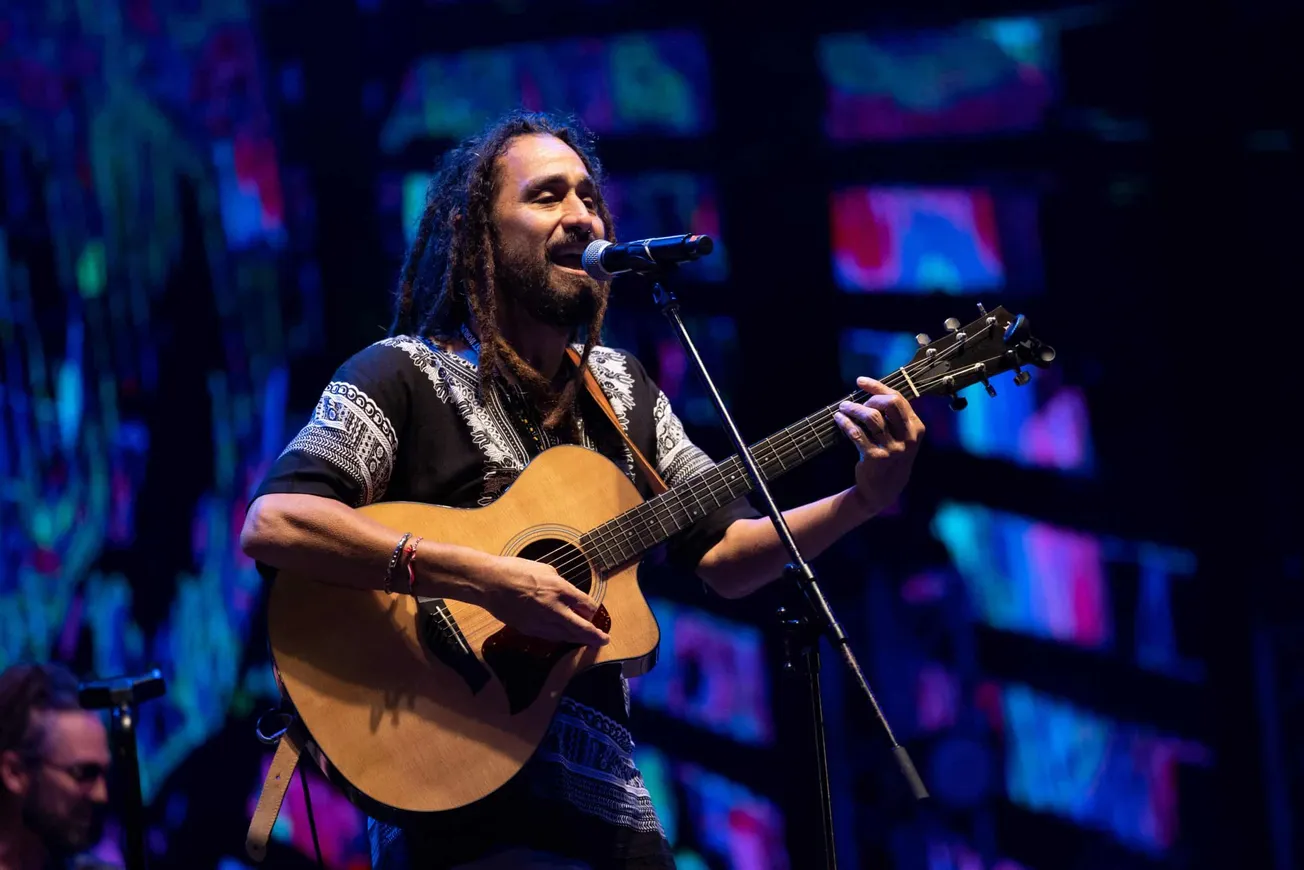
(Feature Image Credit: KUCHING, SARAWAK, MALAYSIA - JUNE 25, 2024: Quino McWhinney of Big Mountain band performs during the Rainforest World Music Festival at Sarawak Cultural Village on June 25, 2023 in Kuching, Sarawak, Malaysia. Photo by Robertus Pudyanto/Getty Images)
*This interview was updated with photos and republished on July 16, 2024.